
Research
From Grid to Plastic
An essay on how architecture quietly produces capitalism — not as a reaction to it, but as one of its instruments. It begins not with money, but with a line.
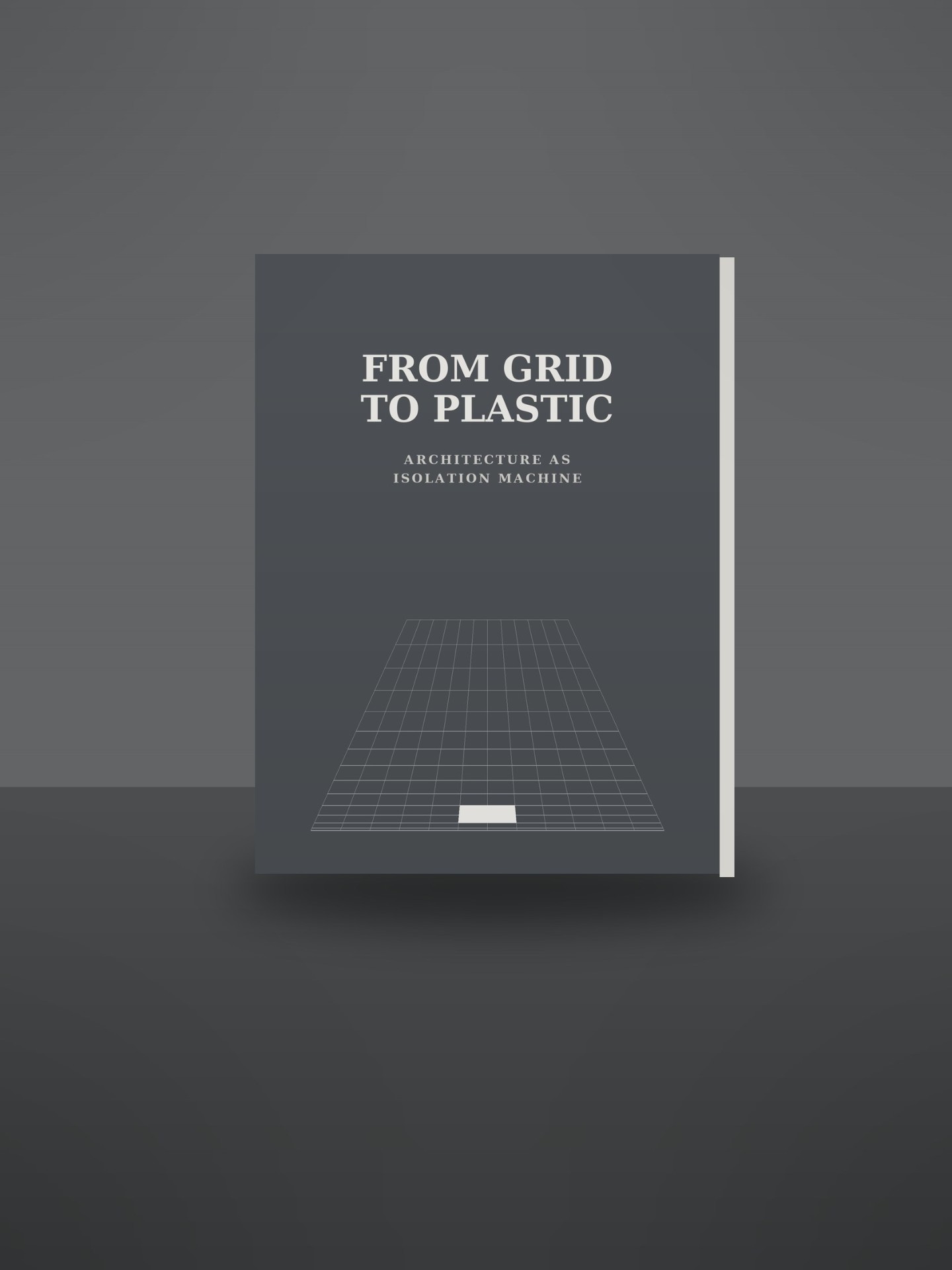
The grid is where it starts. By dividing land into abstract, repeatable units, it privileges legibility, control and exchange over the specifics of terrain. It is not only a technical tool but a worldview — one that trains us to see land as commodity, space as resource, and separation as normal. Capitalism, in this sense, often begins with a line before it begins with money.
Drawing on Escobar's reciprocity, Barber's Comfortocene and Foucault's discipline, the essay reads design as something that uses us back: comfort-driven interiors, surveillance layouts, and sealed materials that quietly train dependence and distance from consequence. Plastic becomes the clearest symbol — solving every problem through enclosure, replacing knowledge of materials and other living things with universal containment.
Against this, it turns to Haraway's call to stay with the trouble and Tsing's life in capitalist ruins — entanglement and friction over optimisation and control. It closes on a commitment: to design that reintroduces consequence rather than insulating us from it, sometimes through honest discomfort, asking of comfort, technology and sustainability what they normalise, hide and exclude.
The central danger of contemporary architecture is not extraction, but isolation from consequence.
At a glance
- Type
- Reflective essay
- Themes
- Capitalism, comfort, materiality, ecology
- Year
- 2025
- Format
- Written essay
Other practices